


There's a nervous excitement. I can see the frosty air coming from my fellow runners as they do the "starting line" jiggle on the starting line.
A quick flick of the hips.
I'm at my local Saturday morning race and I mean business. It's almost time...
Hold on. I need to sort my device. The same goes for the runner alongside me.
The person waiting tuts. I'm not moving until… yes! Signal acquired, away I go.
Amidst the crowd, it's challenging to find a person without a wearable on it. And this extends beyond us athletes who wear them.
This is a explosive, multi-billion pound industry. Names like Garmin dominate, featuring an wide range of diverse devices to suit a range of needs. Depending on how high tech the device you select, prices can vary between a hundred pounds to a significant investment.
"It drives me insane, I can't stop checking."
"It provides solace… It feels like a supporter supporting me."
"Stop telling me about a poor sleep."
Just some of the reactions people have shared from fellow tracker enthusiasts when I question what they feel about theirs.
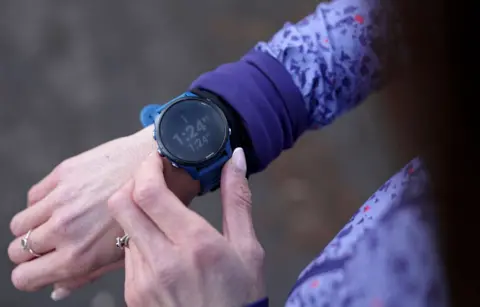
The Monitoring Conundrum
My feelings on my own device? At this moment, frustrating. It's indicating my speed is wrong, making me wonder whether the overhead branches I'm passing under are interfering with my satellite signal.
Countless individuals of us strap these little gadgets onto our arms and keep them on constantly, ostensibly at ease with the fact they're continuously tracking us.
Gone are the days when we relied on them only to give us an rough count of our pedometer reading. Today, they can measure our sleep patterns, heart rate, glucose levels, our recovery score.
It's difficult to find a health indicator they aren't designed to measure.
But can they do what they advertise? And are the data points we obsess over a accurate representation of the truth? Do they boost our overall health, or do the avalanche of measurements and cheerleading alerts just contribute to our everyday anxiety?

A Love-Hate Relationship
"I become a a little preoccupied with mine," a wearer admits.
While she appreciates how her device tracks her runs, she finds some of its other features "daunting" at times - a feeling that became apparent during a significant period.
Prior to discovering she could adjust the settings, her smartwatch kept telling her she was failing to be productive enough. Later on, the watch keeps telling her she's had a bad night's sleep.
"I've got a six-month old, I don't need to be told I've not slept," she says. "I'm acutely aware all too clearly."
Couldn't she just stop wearing it?
"It's possible, theoretically, but I'm in this push-pull dynamic with it," she continues. "I love it for its workout tracking, I just wonder whether the additional features it can now do is possibly overkill for me."
The Technology Behind the Tracking
Each model of smartwatch has its own novel way of measuring your health metrics and interpreting your data, but the vast bulk use sensors on the underside of the watch.
They typically shine minute LED lights onto your arm which can monitor capillary action, recording your pulse rate. Sophisticated devices measure changes in the bioimpedance that passes over the skin to assess your nervous system activity.
A Fine Balance
One expert says that overall for smartwatches, it's a "fine balance" - while the ever-evolving tech could realistically save lives, "identifying issues before we feel unwell", it could also turn us the tracked into the "concerned but fine".
He points out that newer wearables can carry out tests like electrocardiograms (ECGs), which regularly monitor how normal the heart is. They can notify if someone is experiencing an irregular rhythm, where there is abnormal impulses in the heart causing an irregular heartbeat.
This does not automatically signal someone is about to have a cardiac event, but it can give an early warning they might be more susceptible of a heart problem in the future.
But how to make sense of these readings is complex. The expert worries that as more functions are added, people may not be able to fully contextualise their data.
"I remain sceptical that the ability to monitor so many things is such a beneficial thing," he says.
A professor studying wearable tech echoes this sentiment. Her work into the impact of wearable tech on a cohort of heart condition patients suggested a minority of those who were given devices to monitor their condition experienced heightened worry and were "more inclined to use doctor's time".
She observed a vicious circle with her patients - they spotted a concerning reading on their watch. They became worried. Their pulse rose. They got more worried. They checked again, and their anxiety increased again.
"Upon viewing stats about ourselves that we don't really understand then, of course, we are going to become concerned," the psychologist says. "We monitor, we check again - it becomes a feedback loop."


